Sole Trader vs Limited Company Calculator
 Ellie Sleightholm
Use this sole trader vs. limited company calculator to compare your take-home pay under both structures for the 2026/27 tax year. Enter your expected profit, and the calculator shows income tax, National Insurance, corporation tax, and dividend tax side by side and then tells you honestly which structure leaves more in your pocket once running costs are included.
A lot of the advice you will read online, including the popular rule that you should go limited at £35,000 of profit, is based on the old rates. The numbers below use the current ones.
Changed in April 2026
The dividend tax rose by 2 percentage points at the basic and higher rates, and that increase wiped out most of the headline tax advantage a limited company used to have.
Basic rate dividends
10.75%
Higher rate dividends
35.75%
Step by step
How to Use This Calculator
- 1
Enter your profit
Revenue minus expenses, or the profit figure straight from your accounts.
- 2
Add any other income
A salary from employment, rental income or a pension changes which tax bands your profits land in. This matters if you run a business alongside a PAYE job.
- 3
Set how much you want to take out
The extraction slider is the heart of the limited company side. Take everything and you pay dividend tax on it all. Leave profit in the company and it has only suffered corporation tax, with the personal tax deferred until you draw it.
- 4
Tell it about staff
A company whose only employee is the director cannot claim the employment allowance, so it pays 15% employer National Insurance on salary above £5,000. Employ anyone else above that level, and up to £10,500 of that bill disappears.
- 5
Add pension contributions
Employer pension contributions from a company come out of profit before corporation tax with no National Insurance at all. The calculator models this against personal contributions as a sole trader.
- 6
Adjust the running costs
The default assumes a limited company costs about £1,200 a year more in accountancy and filing fees. Change it to your own quote.
2026/27 rates
How Each Structure Is Taxed in 2026/27
Sole trader
As a sole trader, you and the business are legally the same person, and you pay tax on all profits through self-assessment whether you spend them or not:
- Income tax, £12,570 to £50,270
- 20%
- Income tax, up to £125,140
- 40%
- Income tax, above £125,140
- 45%
- Class 4 NI, £12,570 to £50,270
- 6%
- Class 4 NI, above £50,270
- 2%
Limited company
A limited company is a separate legal entity. The company pays tax on profits, and you pay personal tax only on what you extract:
- Corporation Tax, profits up to £50,000
- 19%
- Corporation Tax, above £250,000
- 25%
- Marginal relief band (effective)
- 26.5%
- Dividend allowance
- £500 tax-free
- Dividends: basic / higher / additional
- 10.75% / 35.75% / 39.35%
Myth vs maths
The £35,000 Myth: When Should You Actually Go Limited?
For years, the standard advice was that a limited company starts paying for itself somewhere around £30,000 to £40,000 of profit. That guidance is now out of date. Since the April 2026 dividend rise, a director who extracts all profit each year takes home roughly the same as a sole trader at most profit levels and often slightly less once the extra £1,000 to £2,000 of annual running costs are counted.
Here is the comparison at two profit levels, with the director taking a £12,570 salary and drawing everything else as dividends:
| Profit: £60,000 | Profit: £88,000 | |
|---|---|---|
| Sole trader take-home | £46,111 | £62,351 |
| Limited company take-home | £46,091 | £59,543 |
| Difference | £20 to sole trader | £2,808 to sole trader |
| After typical extra Ltd running costs | Around £1,200 to a sole trader | Around £4,000 to a sole trader |
£60,000
The two structures land within £20 of each other before costs.
£88,000
The sole trader is clearly ahead because a large slice of the dividends falls into the new 35.75% band on top of corporation tax already paid.
The pattern the calculator's chart makes obvious: on full extraction, there is no longer a profit level where incorporating saves meaningful tax. The case for a limited company now rests on how you use it, not on headline rates.
Where it still pays
When a Limited Company Still Wins
You retain profits
Profit left in the company has paid only corporation tax, as low as 19%. A sole trader is taxed on everything in the year it is earned. If you need £40,000 to live on and the business makes £80,000, the company shelters the difference until a leaner year, a big purchase, or retirement.
You are heading past £100,000
Total income above £100,000 erodes your personal allowance, creating a 60% effective band. A company lets you cap your personal income below the cliff and hold the rest back. A sole trader has no such lever.
You use pension contributions
An employer contribution from the company is deductible against Corporation Tax and attracts no income tax or National Insurance on the way in. It is now the most efficient way to get money out of a business, and it only exists in this form inside a company.
You split income
Shares can be held by a spouse, using two sets of allowances and basic rate bands.
You buy equipment or vehicles
Companies get full expensing on new plant and machinery, and a new electric car through the company gets 100% relief in year one. Our capital allowance calculator shows the relief on any planned purchase, and if you take a car through the company, our benefit-in-kind calculator shows the personal tax side.
You want limited liability
If the business fails, your personal assets are protected. No tax table captures what that is worth, and for anyone in construction or other high-risk trades it can outweigh everything above.
The admin
The Costs Nobody Mentions Until You Have Incorporated
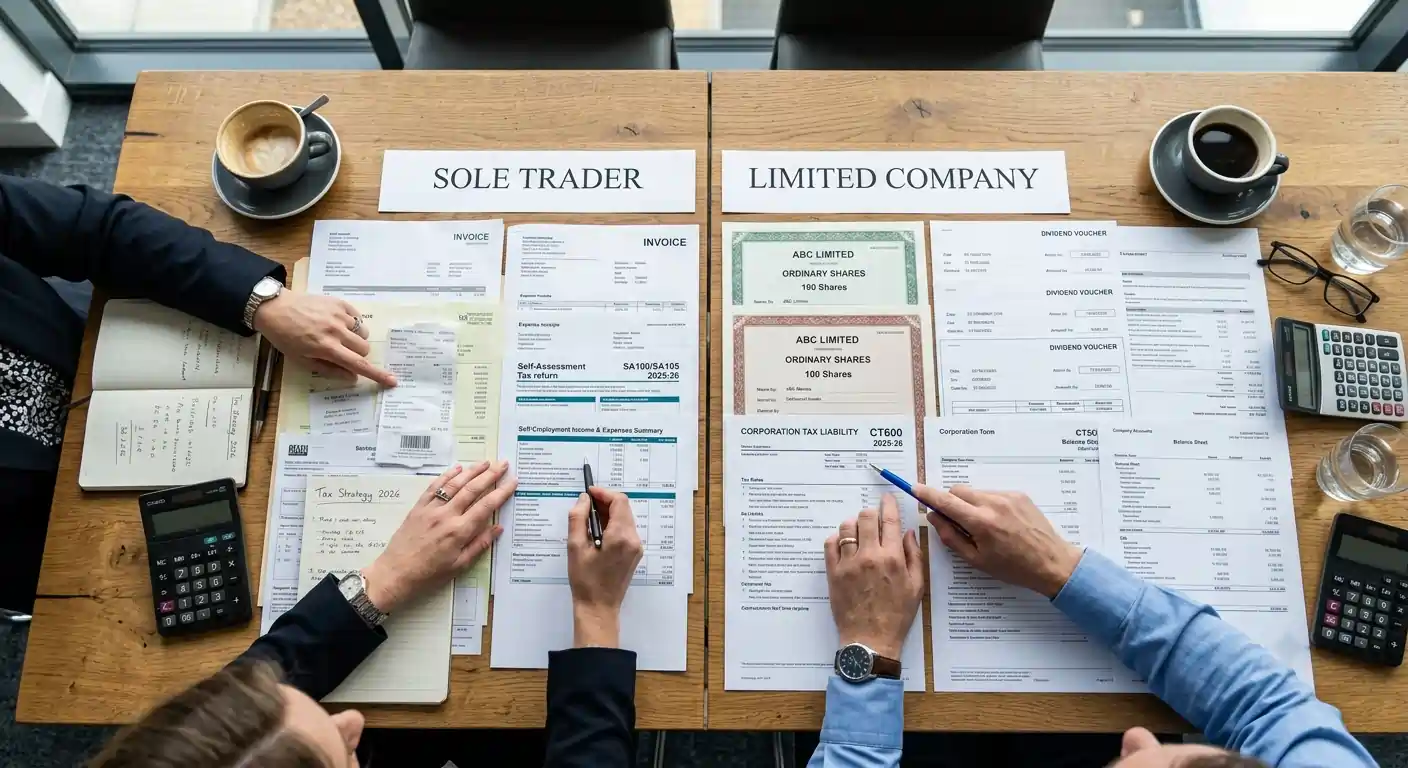
Talk to anyone who has made the switch, and the surprise is rarely the tax. It is the admin. A limited company means statutory accounts, a corporation tax return, a confirmation statement (£34 a year), payroll filings, and a public record of your name and company details at Companies House.
- Typical limited company accountancy fees a year
- £800–1,500
- Typical sole trader accountancy fees a year
- £200–500
- Realistic extra yearly budget before any tax saving
- £1,000–2,000
Realistically, budget an extra £1,000 to £2,000 a year before you have saved a penny of tax, which is exactly why the calculator asks for your running costs and nets them off the verdict.
Year one
Starting a Business That Will Make Losses First?
Structure matters most in year one.
Sole trader losses
A sole trader's early losses can be set against other income in the same year, including a PAYE salary, generating a real tax refund when cash is tightest.
Company losses
Company losses are trapped inside the company: useful against future company profits and worthless if the venture never becomes profitable.
If you are building something alongside a day job and expect startup costs before revenue, starting as a sole trader and incorporating once profitable is usually the efficient order, and the switch itself is straightforward. The official process for both routes is on GOV.UK's guide to setting up a business.
Contractors
Contractors: Check IR35 Before You Decide
If most of your income comes from one client, especially a current or former employer, the off-payroll working rules can override everything on this page.
Inside IR35, your income is taxed like employment regardless of structure, and the salary plus dividends model stops working. An 18-month contract invoicing your old boss is precisely the arrangement HMRC looks at. Get the contract reviewed before incorporating mainly for tax.
Questions
Frequently Asked Questions
Do I pay less tax as a sole trader or a limited company?
If you extract all profit every year, a sole trader now usually pays the same or less overall once the April 2026 dividend rates and company running costs are counted. A limited company pays less when you retain profits, make employer pension contributions, or split income with a spouse.
How much can a sole trader earn before 40% tax?
The higher rate starts at £50,270 of total income. Below that, you pay 20% income tax plus 6% Class 4 National Insurance on profits above £12,570, an effective 26%.
Is it better to earn £50,000 or £55,000?
£55,000, always. Only the income above £50,270 is taxed at the higher rate, not your whole income. Crossing a threshold never leaves you worse off overall; it just means the extra pounds keep less of their value.
How much tax will I pay on £20,000 as a self-employed person?
Around £1,930 for 2026/27: roughly £1,486 of income tax and £446 of Class 4 National Insurance, leaving about £18,070 after tax. Any other income on top changes the figures, which is what the other income field in the calculator is for.
How much can I earn without declaring myself self-employed?
£1,000. The trading allowance lets you earn up to £1,000 of self-employment income in a tax year with no registration and no tax return. Above that, you must register for Self Assessment by 5 October after the end of the tax year you started.
Can I run a limited company without an accountant?
Legally yes. Nothing requires a company to appoint one, and small companies are exempt from an audit. Practically, most owner-directors find that corporation tax computations, statutory account formats, and payroll are worth outsourcing, which is why £800 to £1,500 a year is the realistic budget rather than zero.
What is the 4-year rule for HMRC?
HMRC can normally go back 4 years to assess underpaid tax. That extends to 6 years where a mistake was careless and 20 years where it was deliberate. It is also the window for you to claim overpaid tax back, so keep records for at least 5 to 6 years, whichever structure you choose.
Do I need to tell HMRC I am a sole trader?
Yes, once you earn more than £1,000 in a tax year from self-employment. Register for Self Assessment by 5 October following the end of that tax year. There is no Companies House involvement and no fee.